Edge AI and data sovereignty
A virtual sensor is only usable where it computes at the point the measured quantity is needed: on the ECU, in the control loop, in operation. Data Sensors therefore exports the trained model as standalone code for exactly that target system, and trains it beforehand entirely on your own machine.
Separating training from inference
Edge AI here means a clear separation: training takes place on the engineer's machine, in every case inside the company network. Inference takes place exclusively on the target system, that is on the ECU. Neither requires an external service. In particular, no measurement data and no models are transferred to an AI provider such as ChatGPT or Claude.
The code Data Sensors generates runs directly on the target system, that is on a microcontroller, in a Simulink block, or in any other environment that executes C, C++, Python or MATLAB. It is a standalone implementation of the prediction function: no dependency on Data Sensors, no runtime library to link against, and no network connection at runtime.
Model size
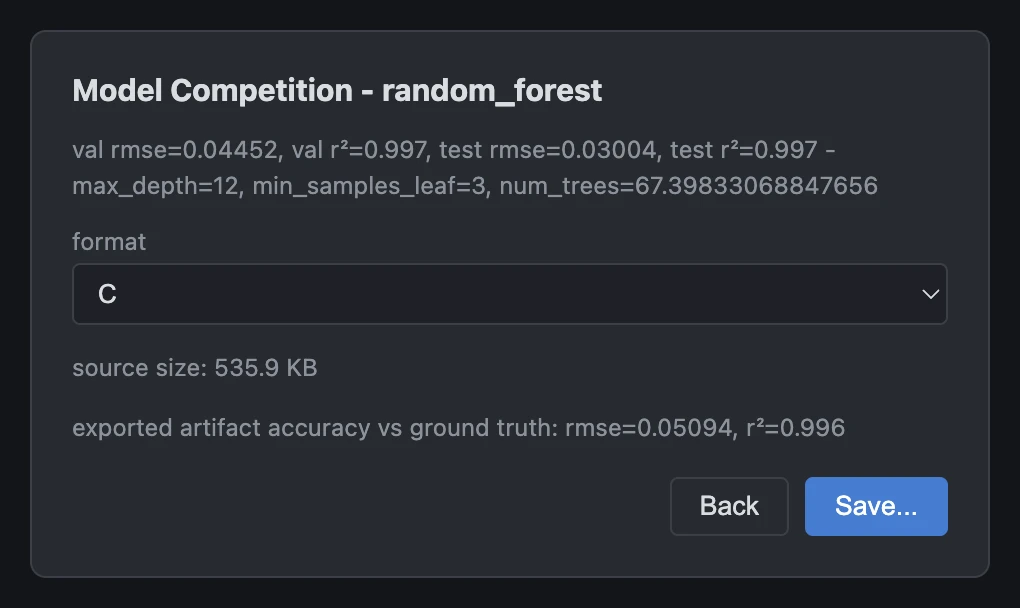
On an ECU the first constraint is not accuracy but space. Every export is therefore available at full precision or int8-quantised, and the export dialog shows an estimate of size and accuracy for both variants beforehand. The trade-off between "fits the flash budget" and "matches the accuracy at training time" is therefore made before saving, not at flashing time.
For the same reason, export is not restricted to the top leaderboard entry: a slightly less accurate random forest may run faster on your target hardware, and a smaller neural network may fit the available memory better. Every entry can be exported individually.
Data sovereignty
Measurement data from testing and calibration is IP-relevant company confidential material and reflects characteristic strategies. It describes the behaviour of a product that is not yet on the market. This data should not reach any cloud.
Data Sensors runs entirely offline: training takes place on your own machine, there is no cloud upload of the measurement data, no account and no registration.
With a Virtual Sensor licence you may use the exported code in your own products without further licence fees. It also remains operable if you stop using Data Sensors later. Details are on the Licensing page.
What this means for your validation
A standalone code artefact with no runtime dependency can be handled with the same tools as the rest of your production code: checked in, reviewed, statically analysed, tested against reference data. Data Sensors supplies the model and the accuracy figures; the assessment of whether a virtual sensor may replace a measuring point rests with the responsible department.