Virtual sensor training and auto-tuning
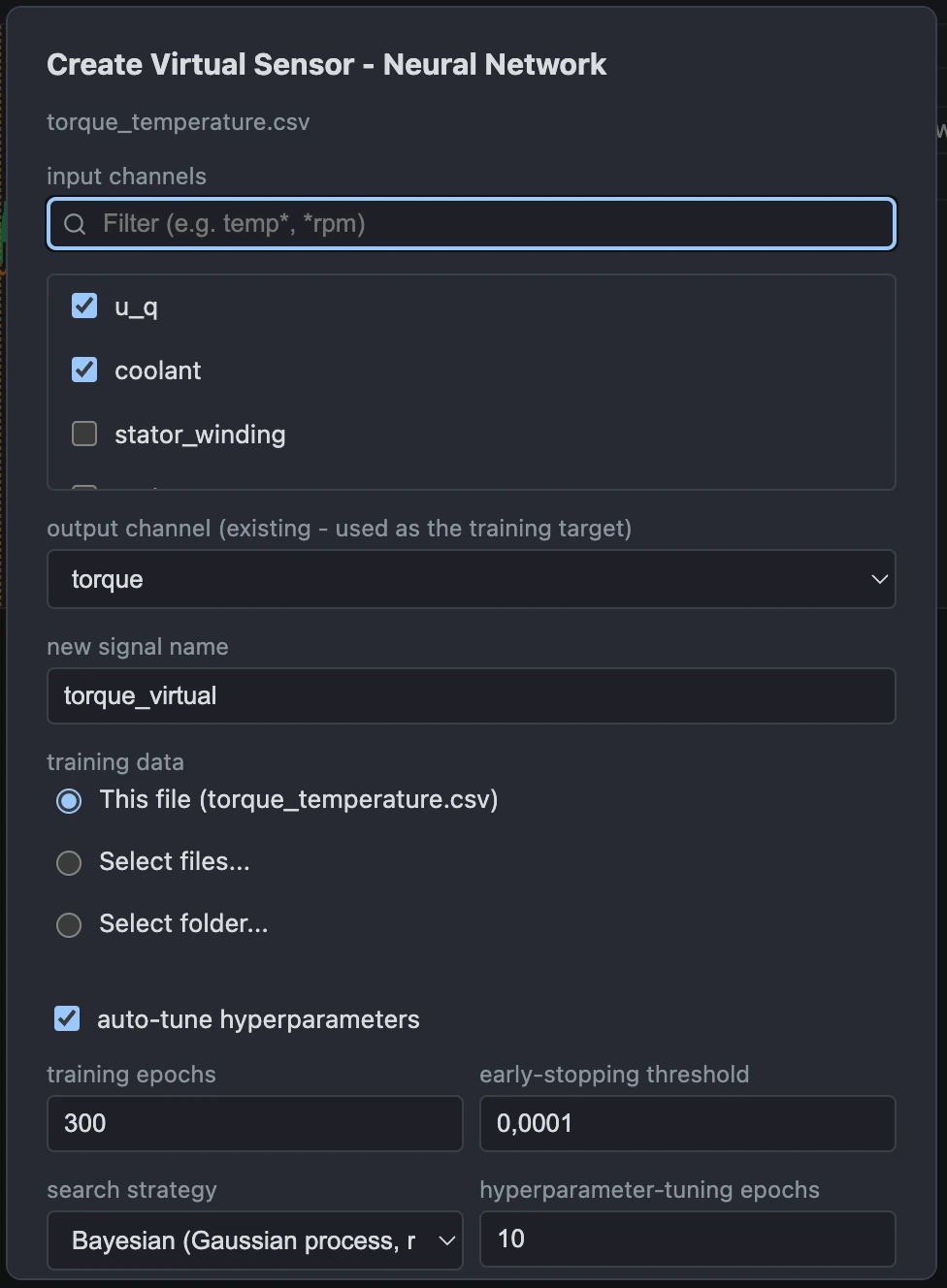
The Virtual Sensor dialog trains a single model - Random Forest, XGBoost, or Neural Network - against an output channel you pick, using whichever input channels you select. Training data can be the currently loaded file, several explicitly selected files, or a whole folder; extra files are concatenated into one training set, and a per-file channel-mapping table (savable/loadable as CSV) handles files that name the same physical signal differently.
All three model types can auto-tune their own hyperparameters instead of requiring hand-picked values, each searching a different space: Random Forest searches tree count, max depth, and minimum leaf size; XGBoost searches tree count, max depth, and learning rate; Neural Network searches layer count, neurons per layer, and learning rate. Every model type shares the same choice of search strategy - Bayesian optimization (Gaussian-process surrogate, the default and usually the fastest to converge), random search, grid search, or a Random Forest/XGBoost surrogate search. When training on multiple files, the hyperparameter search itself only runs against the currently loaded file to stay fast; the winning configuration is then retrained on the full multi-file dataset.